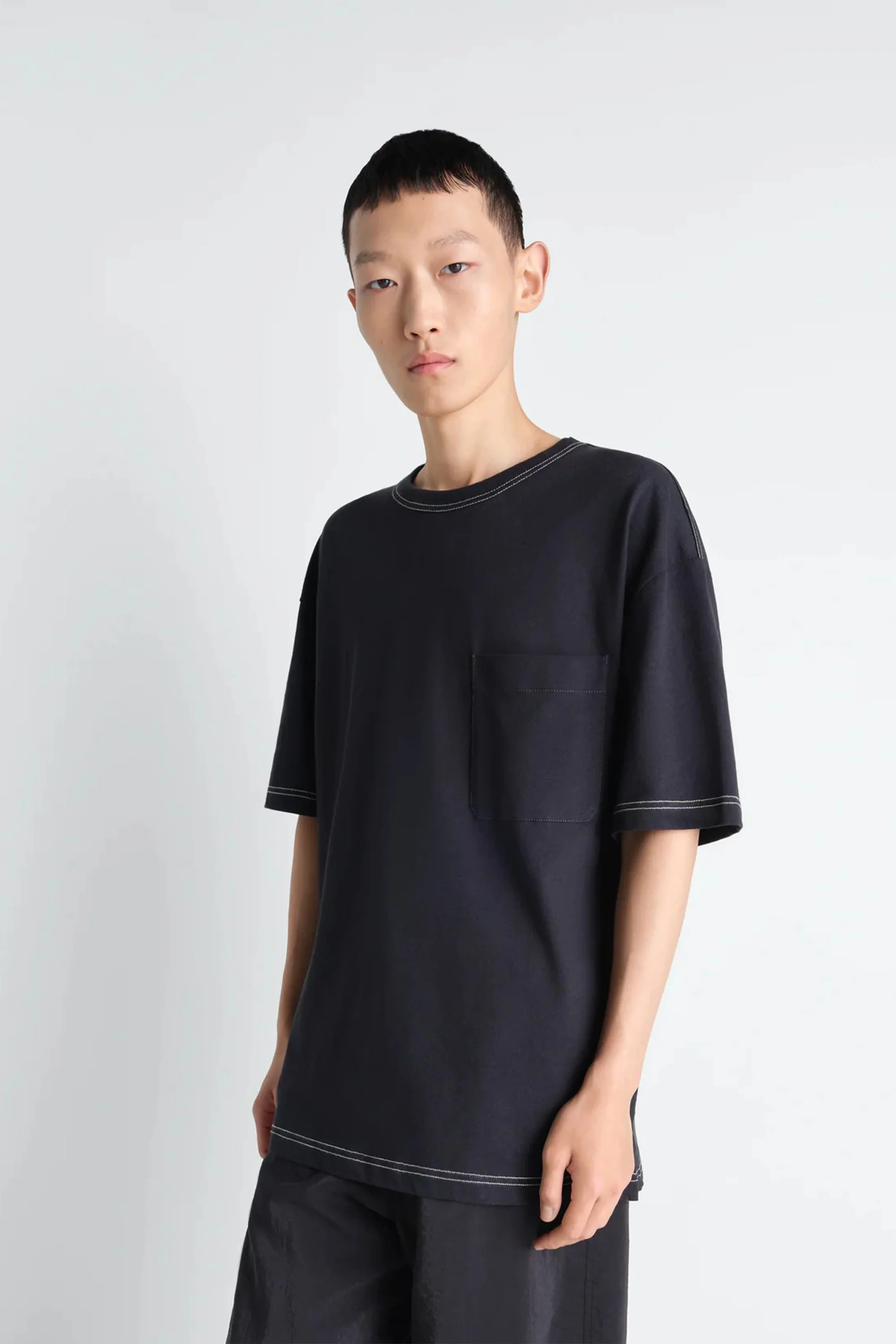
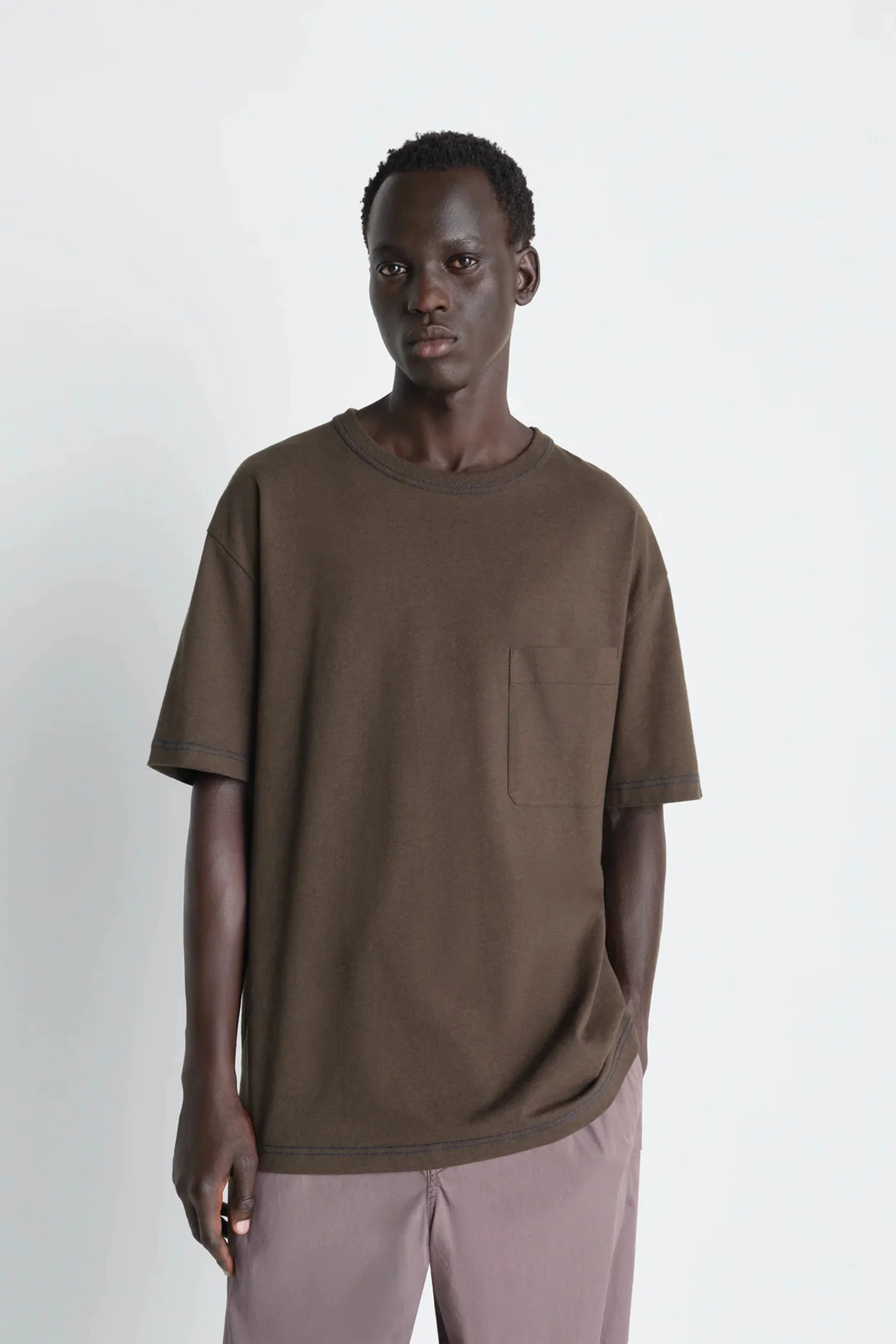
Lot. 601 Tee Shirt Usuzumi
The T-shirt, one of the most iconic garments in American culture, was originally developed as an undergarment to be worn beneath uniforms and military wear. This simple piece reflects America’s commitment to functional, rational design. Its construction, featuring a tubular body known as "marudo" with only openings added for the neck and sleeves, is highly efficient with no excess fabric. While it resembles modern everyday wear in appearance, its essence is fundamentally different. The original design is faithfully reproduced, including the straight shoulder line without slope, a boat-neck-like collar, and a double-layered neck rib to prevent stretching. The tubular jersey fabric is slowly and carefully knitted using a rare loopwheel knitting machine. These machines were introduced to Japan during the Taisho era (1912–1926), and today, Wakayama is the only place in the world where they remain in operation. Although extremely inefficient—producing just one meter per hour—the resulting fabric is soft and airy, with gentle irregularity and rich texture. The use of American cotton enhances the dry touch and distinctive hand feel. Each YAKUSUGI, SAKURA, MUD DYED BROWN, and USUZUMI piece is dyed by hand, one by one. No two garments are exactly alike, giving each one a truly unique expression.
Original: $559.92
-65%$559.92
$195.97Product Information
Product Information
Shipping & Returns
Shipping & Returns
Description
The T-shirt, one of the most iconic garments in American culture, was originally developed as an undergarment to be worn beneath uniforms and military wear. This simple piece reflects America’s commitment to functional, rational design. Its construction, featuring a tubular body known as "marudo" with only openings added for the neck and sleeves, is highly efficient with no excess fabric. While it resembles modern everyday wear in appearance, its essence is fundamentally different. The original design is faithfully reproduced, including the straight shoulder line without slope, a boat-neck-like collar, and a double-layered neck rib to prevent stretching. The tubular jersey fabric is slowly and carefully knitted using a rare loopwheel knitting machine. These machines were introduced to Japan during the Taisho era (1912–1926), and today, Wakayama is the only place in the world where they remain in operation. Although extremely inefficient—producing just one meter per hour—the resulting fabric is soft and airy, with gentle irregularity and rich texture. The use of American cotton enhances the dry touch and distinctive hand feel. Each YAKUSUGI, SAKURA, MUD DYED BROWN, and USUZUMI piece is dyed by hand, one by one. No two garments are exactly alike, giving each one a truly unique expression.