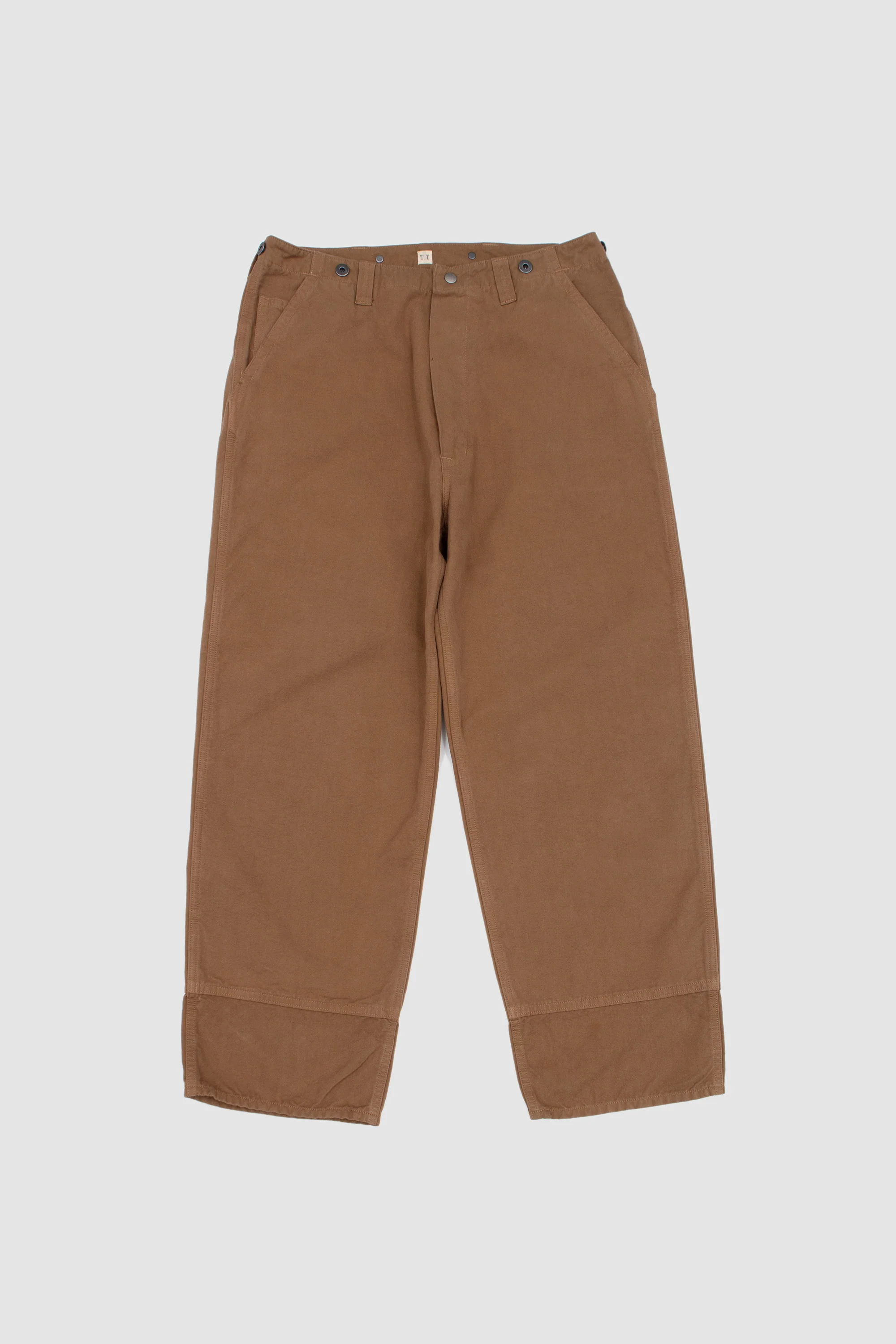
Lot. 219 Logger Pants Forestry Khaki
These logger pants are designed based on the trousers worn by forest workers of the Civilian Conservation Corps (CCC) around 1934. Same as the Lot.325 Logger Jacket, they use durable cotton canvas fabric. This fabric seemed to be selected by the Philadelphia Quartermaster Depot—then responsible for military clothing production—for CCC tents and sleeping bags, which suggests that these pants originated in the same period. The pants feature a double-knee construction up to below the knees. The original design was reportedly soaked with oil for waterproofing, treating the garment more like a tool than clothing. All buttons are made of metal, pursuing uncompromising durability.
The Lot.219 Logger Pants are garment-dyed to resemble the tones of workwear worn by CCC forest workers. As a special piece, these pants are dyed with kakishibu (fermented persimmon tannin), which has traditionally been used to strengthen fabric. In addition, a unique ink-marbling pattern called Suminagashi, resembling the rings of a tree, was individually transferred from the surface of water. This marbling technique, originating from a pastime of the Heian period, involves dripping ink slowly at the center of a water surface. Each garment is floated on this inked surface and the pattern is transferred. Due to subtle movements in the air and water, no two patterns are ever the same. By entrusting the final touch to nature, the design captures not only the uncontrollable beauty of natural forces, but also the passage of time as each ring forms.
Original: $1,627.06
-65%$1,627.06
$569.47Product Information
Product Information
Shipping & Returns
Shipping & Returns
Description
These logger pants are designed based on the trousers worn by forest workers of the Civilian Conservation Corps (CCC) around 1934. Same as the Lot.325 Logger Jacket, they use durable cotton canvas fabric. This fabric seemed to be selected by the Philadelphia Quartermaster Depot—then responsible for military clothing production—for CCC tents and sleeping bags, which suggests that these pants originated in the same period. The pants feature a double-knee construction up to below the knees. The original design was reportedly soaked with oil for waterproofing, treating the garment more like a tool than clothing. All buttons are made of metal, pursuing uncompromising durability.
The Lot.219 Logger Pants are garment-dyed to resemble the tones of workwear worn by CCC forest workers. As a special piece, these pants are dyed with kakishibu (fermented persimmon tannin), which has traditionally been used to strengthen fabric. In addition, a unique ink-marbling pattern called Suminagashi, resembling the rings of a tree, was individually transferred from the surface of water. This marbling technique, originating from a pastime of the Heian period, involves dripping ink slowly at the center of a water surface. Each garment is floated on this inked surface and the pattern is transferred. Due to subtle movements in the air and water, no two patterns are ever the same. By entrusting the final touch to nature, the design captures not only the uncontrollable beauty of natural forces, but also the passage of time as each ring forms.